About Us
Learn how we have become a leading, global rare disease biotech company focused on delivering medicines for people living with genetically defined conditions.

BioMarin’s story begins with a father who refused to accept that there were no options for his son, who was living with a rare condition. That belief – that a different future was possible – is not just where BioMarin began. It is what drives our work today.
1991, Carrollton, Texas. Mark Dant remembers watching his then 3-year-old son Ryan playing baseball and running around outside – Ryan was a big Texas Rangers fan, who demonstrated unusual athletic ability for such a young child. Then, during a routine checkup, Ryan’s pediatrician noticed that Ryan’s liver seemed too large. Out of an abundance of caution, the pediatrician sent the family to a geneticist. What that geneticist found changed everything.
Ryan was diagnosed with a form of mucopolysaccharidosis, or MPS, a rare genetic condition in which the body is missing an enzyme needed to break down certain sugars. Without that enzyme, sugars build up in the body, damaging organs and tissue over time. With no treatments for the condition at the time, doctors believed it was unlikely that Ryan would live beyond the age of 10. Ryan’s mother, Jeanne, recalls the choice that her family faced in those early days: give up or find the courage to make their way through it. The Dants chose the second, starting The Ryan Foundation to raise money for MPS research.
The first event, a bake sale, brought in $342.
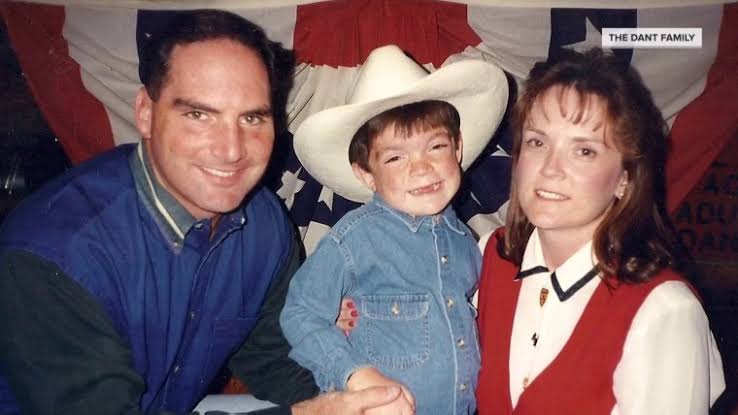
Mark and Jeanne Dant learned their son, Ryan, was living with mucopolysaccharidosis when he was a young child and were originally told he likely would not live past the age of 10.
In the early 1990s, conditions like MPS were often considered too rare and too complex to deliver the kinds of breakthroughs many biopharmaceutical companies sought. Much of the infrastructure that exists today – patient registries, online communities, advocacy networks, specialized biotech firms – was nascent. For Mark, a police officer without scientific training, that meant figuring it out the hard way: driving to the local library, photocopying pages from a medical dictionary and bringing them home to decode journal articles.
His work eventually led him to a scientific conference in Germany, where he first learned about enzyme replacement therapy – a treatment approach in which a lab-produced enzyme is introduced into the body to compensate for the one it cannot produce on its own. The science had shown promise in conditions similar to MPS. After the presentation, Mark approached the researcher and asked about the potential of an enzyme replacement therapy for MPS. The researcher told Mark it was possible, but cautioned that Mark had neither the time nor the money. The statement was meant to temper expectations, to avoid raising hope. Mark heard something else entirely. He believed, for the first time, that a treatment was possible.
Mark continued attending medical conferences and meetings, where he met Dr. Elizabeth Neufeld, a preeminent geneticist whose foundational work on lysosomal storage disorders had shaped the entire field. Dr. Neufeld introduced Mark to a young physician-scientist, Dr. Emil Kakkis, who had been working for years on MPS under Dr. Neufeld’s mentorship at the University of California, Los Angeles. Dr. Kakkis had developed a recombinant enzyme, which was produced by engineering cells to manufacture the protein that people with MPS cannot make themselves. The enzyme showed meaningful results in preclinical models, but he was struggling to fund the work needed to transform that compound into a pharmaceutical-grade product that could be brought through clinical trials.
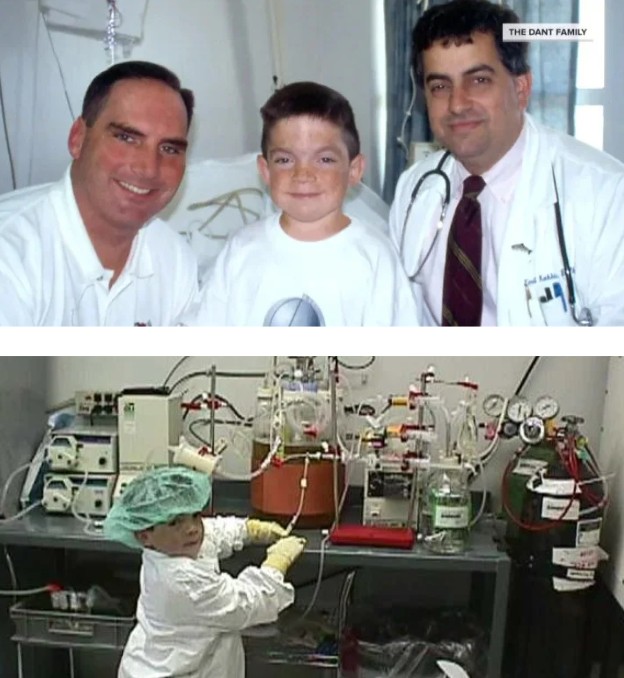
Mark (left) and Ryan Dant are pictured with Emil Kakkis (top image). Ryan is seen in Emil’s UCLA lab where he invented the compound that BioMarin developed into a medicine for MPS (bottom image).
1996–1997, Novato, California. Executives at a small research reagent company called Glyko Biomedical decided to spin out the company’s drug development business. The Glyko team officially formed BioMarin to develop pharmaceutical products, naming the new company after the county in California where it was based. The BioMarin team was on the hunt for research programs to help accelerate the business. A consultant introduced the BioMarin team to Dr. Neufeld and Dr. Kakkis. It was an ideal match. BioMarin was officially spun out of Glyko on March 21, 1997, and 11 days later the new company entered into an agreement with the Harbor-UCLA Research and Education Institute and Dr. Kakkis.
In 1998, Dr. Kakkis joined BioMarin as Chief Medical Officer, moving the MPS program into a setting where the work could be developed, scaled and tested. The move was about more than just cutting-edge science. Through the MPS program, BioMarin would build deep, personal connections with the patients and families who were now counting on the success of the newly formed company. It was a unique approach that would shape BioMarin for decades to come.
That same year, two months before his 10th birthday, Ryan became the third person in the world to receive the then-investigational medicine as part of BioMarin’s first clinical trial. In 2003, that medicine became BioMarin’s first product approved by the U.S. Food and Drug Administration, and the first approved treatment in history for that form of MPS.
Even before that approval, BioMarin had made a bet that spoke to its ambitions. In 1999, just two years after the company was founded, BioMarin broke ground on a biologics manufacturing facility on Galli Drive in Novato. It was a significant capital commitment for a company that had yet to bring a single product to market. It was also a declaration of intent: BioMarin was not building a company around one medicine for one disease. It was building the infrastructure to do much more.
That vision proved out quickly. Even as BioMarin was racing toward the first approval, the team was already applying its understanding of genetics and MPS to a different form of the condition caused by a deficiency of another enzyme. That medicine was approved by the FDA in 2005, becoming the company’s second approved medicine – and second first-in-disease therapy. Critically, despite the strain it put on the company’s resources, BioMarin held firm on its commercialization rights for this second medicine, a decision that proved pivotal in establishing a fully integrated company that could operate as a truly independent global rare disease company at scale. BioMarin’s commercial portfolio today includes nine medicines built deep scientific, manufacturing and commercial expertise.
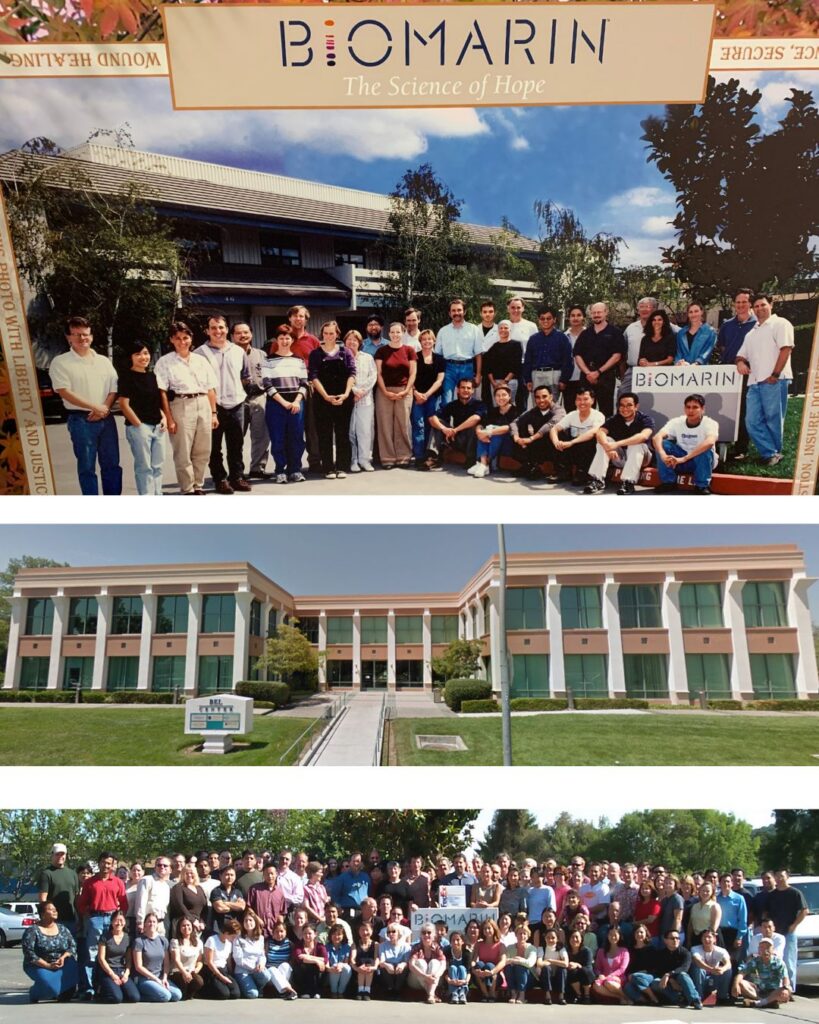
BioMarin initially established a presence in Novato, California before expanding to nearby San Rafael, where the company’s headquarters are today. Building on what it learned from developing the company’s first medicine, BioMarin quickly began applying its understanding of genetics and MPS to develop a second medicine for another form of the condition, which was approved in 2005. Over the years, BioMarin would go on to develop a total of six first-in-disease medicines.
1998, Princeton, New Jersey. Nearly 3,000 miles away, another family faced a life-altering diagnosis. John and Aileen Crowley learned that two of their children, Megan and Patrick, had Pompe disease – another rare lysosomal storage disorder with no available treatments. Like the Dants, the Crowleys were told their children would not live into adulthood.
John, a lawyer who was working at Bristol-Myers Squibb, left his job and founded a biotech company called Novazyme with the goal of developing a treatment for Pompe. Novazyme was eventually acquired by Genzyme, and John went on to play an integral role in the founding of Amicus Therapeutics. Across those companies, his work contributed to the development and approval of three medicines for Pompe disease.
BioMarin acquired Amicus in 2026, bringing together nearly 50 combined years of commitment to patients with rare diseases and the remarkable stories of two families whose determination changed their children’s lives – and the lives of many other families around the world.
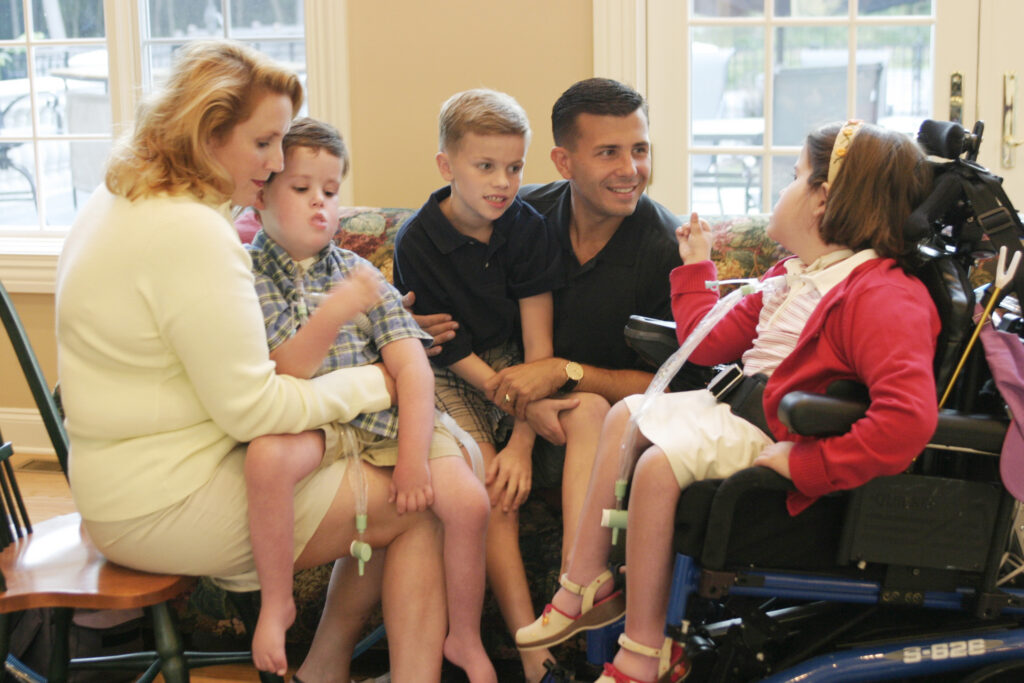
Pictured are John and Aileen Crowley with their three children (from left) Patrick, John Jr. and Megan. When Patrick and Megan were diagnosed with Pompe disease, John left his job as a lawyer at a pharmaceutical company and founded a biotech company with the goal of developing a treatment for Pompe. His efforts eventually helped lead to three approved Pompe medicines.
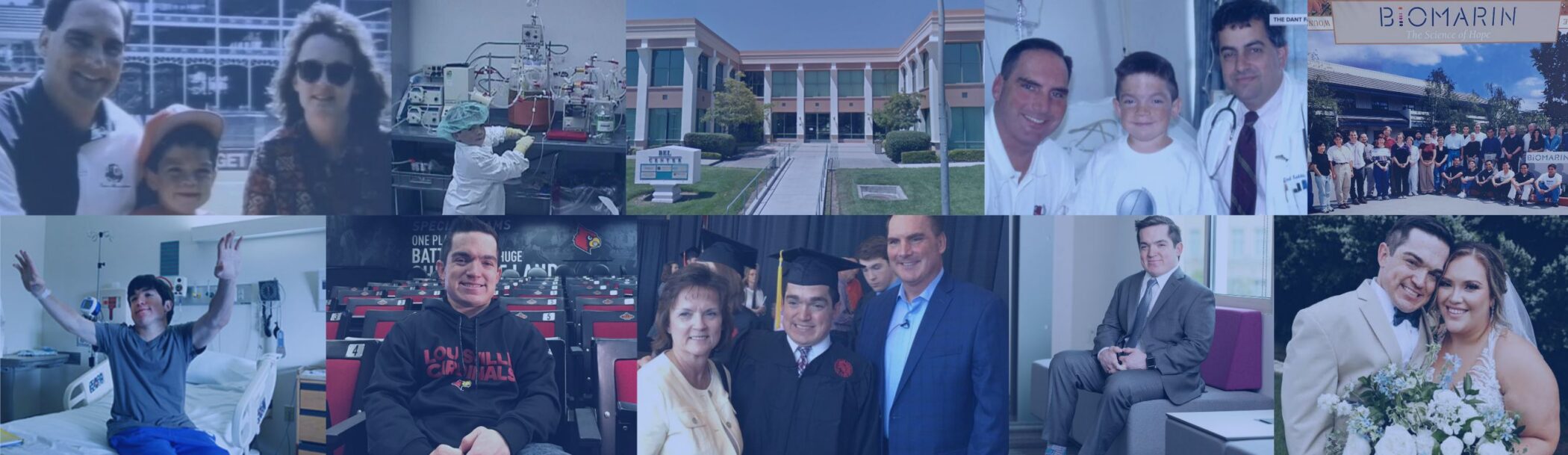
Today, Ryan Dant is in his 30s, one of the oldest known people living with the form of MPS with which he was diagnosed. Ryan graduated from college, built a career and got married. Megan Crowley has a master’s degree in social work and Patrick lives in New Hope, Pennsylvania, where he works at a local flower shop.
The stories of Ryan, Megan and Patrick stand as a reminder of what is possible when patients and their families are at the heart of clinical development. Today, BioMarin has built its portfolio of nine approved therapies by applying the same approach of deep scientific understanding, close collaboration with patient communities and a willingness to take on challenges others avoid.
Yet for all the progress that has been made, much work remains to be done. And so, the story of these two families and their dreams for the future is shared by so many others in the rare disease community, and by more than 3,000 BioMarin employees around the world.
Because the future is a story we are writing together …
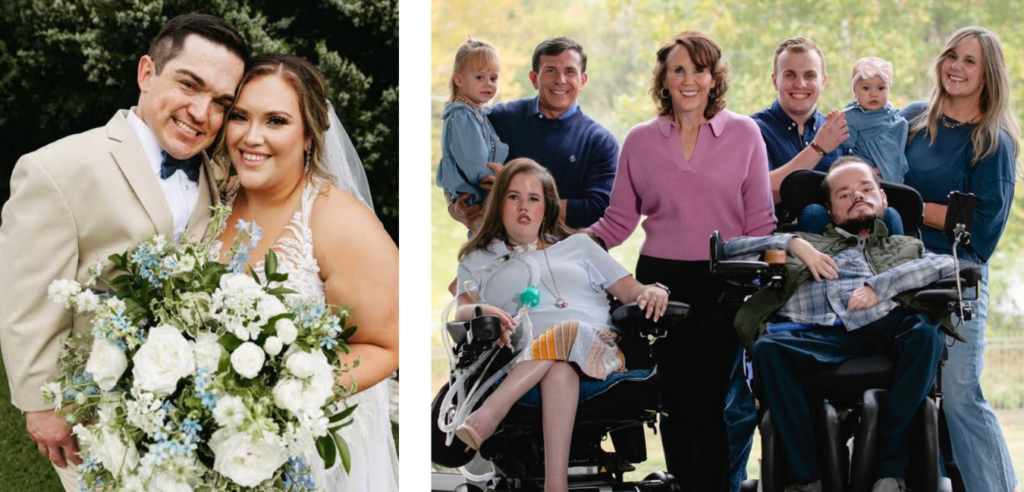
Ryan has graduated college, built a career and married his wife, Silvia, in 2021. Pictured on the right, Megan went on to earn a master’s degree and Patrick works at a flower shop.
Learn how we have become a leading, global rare disease biotech company focused on delivering medicines for people living with genetically defined conditions.
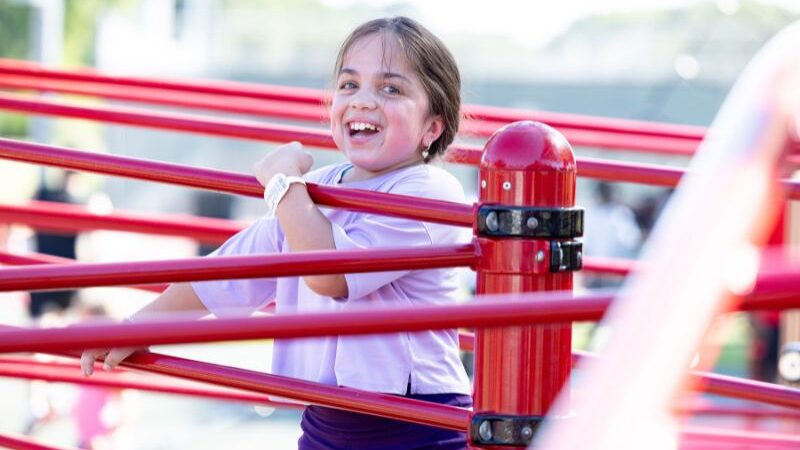
Discover how we support the communities we serve and why our operating operating principles start and end with patients.
Read the latest updates about BioMarin and learn more about our science, our people and the communities we support.